

Bringing Awareness to Disconnection
written by David McCallum
originally published June 3, 2025

Photo by Patty Apostolides on Unsplash
Exercise
Take several deep breaths (in through your nose and out through your mouth)…
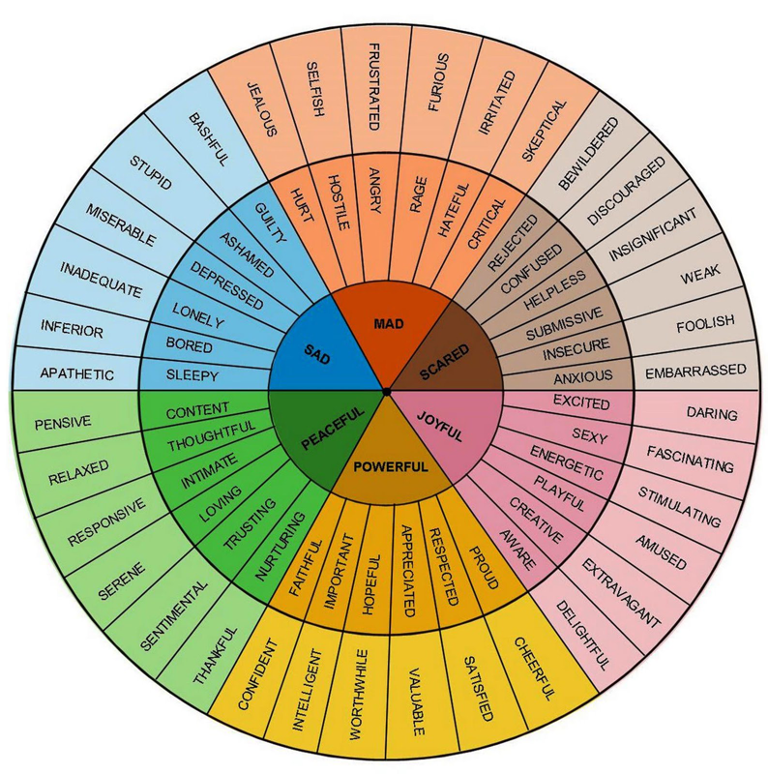
Recall a time when you felt disconnected from yourself and/or others. What was it like for you in that state? Perhaps certain emotions showed up for you, like grief, sadness, shamefulness or disgust. Refer to the “Emotion Wheel” below and see which emotions resonate with your experience of disconnection.
As you bring some awareness to these emotions, do you notice any feelings and sensations within and around your body? There may be some heaviness, tension, a low/slow heart rate, or the urge to cry. Refer to the “Emotion Sensation Wheel” below as a reference for feelings and sensations that show up within and around the body.
If it feels safe for you to do so, stay with these emotions and their accompanying feelings and sensations. Are there any messages in the form of words, shapes, or colours that they are sending you? Something may or may not show up for you as you tune into them. The important thing is that you are taking some time to slow down and connect in this moment. In doing so, you are sending a very important message back to them: they are loved and accepted. This is the essence of compassion (a.k.a. heartfelt understanding), and compassion facilitates and deepens connection.
Now, having offered some compassion to these emotions and their feelings and sensations, what are you experiencing within your system? Is there any release of heaviness and tension? Even just a little (i.e. 10-20%) can mean a lot. Take a few moments to stay with whatever sense of connection you are experiencing. Having done so, take a look at “8 Cs of Self Leadership Wheel” listed below and see if what you experienced is encapsulated in these qualities. This is by no means an exhaustive list, but they can provide some understanding of what it means to feel connected to ourselves and others.
Reflection
In considering what we have come to label as depression, it is vitally important to get curious about its potential origins. In her research and practice, psychotherapist Hilary Jacobs Hendel explores the sources that contribute to depression (refer to It’s Not Always Depression). One primary source is a sense of shamefulness.
As noted in the above exercise, shamefulness is a complex emotion that contributes to a deep sense of disconnect with ourselves and others, and it often has its origins in a much earlier time in our lives. In his work, Dr. Gabor Maté shows that if a child is consistently concerned about having their need for outer attachment met (i.e. with caregivers), then they will sacrifice their inner connection with their authentic Self. Such a severing of connection with one’s authentic Self creates a profound sense of grief and can allow for shamefulness to dominate the system (refer to The Myth of Normal). The disconnection that shamefulness brings can, in many cases, be understood as depression. What is needed to help treat depression is not only therapies like cognitive behavioural therapy (CBT) and dialectical behaviour therapy (DBT), but also relational therapy models like internal family systems (IFS), accelerated experiential dynamic psychotherapy (AEDP) and others that emphasize a sense of compassion and curiosity about what is arising within one’s system.
If you are experiencing a sense of depression in your life, and perhaps feeling stuck in it, I would invite you to connect relationally with it. You can do so through mindfulness exercises, like the one listened to above, and also with a trained therapist who embodies compassion and curiosity for you and your system. Only through connecting relationally with these emotions (or parts) can they be healed from the often profound sense of disconnection they have experienced at very crucial times in life.
For more information, check out…
It’s Not Always Depression by Hilary Jacobs Hendel
The Myth of Normal by Gabor Maté
